

How to Choose Authentic Emerald Jewelry: A Buyer's Guide to Color, Clarity, and Setting
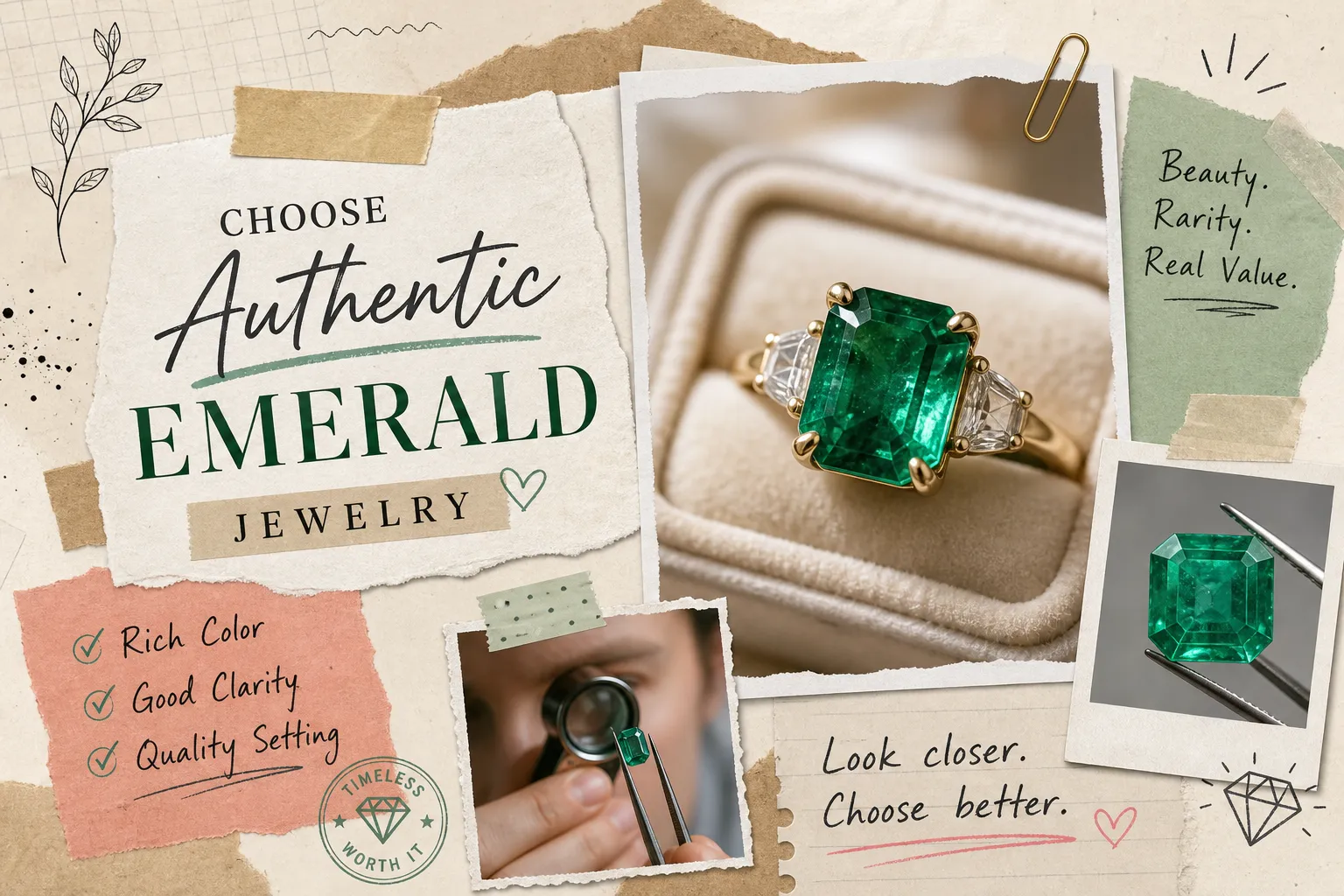
Emerald jewelry has outlasted almost every trend in fine jewelry history. Ancient royals prized the stone for its vivid color and symbolic power, and Hollywood icons like Elizabeth Taylor were famously devoted to it. Today, emeralds are increasingly popular among brides who want color, meaning, and something that stands apart from a traditional diamond. But buying emeralds without the right knowledge is one of the fastest ways to overpay or end up with a stone that isn't what you think it is.
At Flawless Jewels NY, clients ask us about emeralds more than almost any other colored gemstone, and the questions are always the same: Is it real? Is it treated? What should I actually pay? These are exactly the right questions to ask. This guide answers all of them, so by the time you finish reading, you'll know how to assess quality, spot treatments, choose the right setting, and shop with genuine confidence, whether you're buying an emerald engagement ring, a statement necklace, or a birthday gift that will last a lifetime.
What actually makes an emerald valuable
Most buyers assume all emeralds are created equal. They aren't. Emerald quality is driven by four factors: color, clarity, cut, and origin. Color is the most important by a significant margin, accounting for roughly 50 to 70 percent of a stone's value. The ideal emerald shows a vivid to intense green or bluish-green with strong saturation, not too dark, not washed out. When you see that color in person, you're looking at what the trade calls fine quality.
Color and saturation: the factor that moves the price the most
The color spectrum in emeralds runs from pale, watery green all the way to deep forest tones. The sweet spot is a pure vivid green to slightly bluish-green with strong saturation and a medium to medium-dark tone. Stones that read as pale or brownish under normal lighting are considered commercial quality and trade at a steep discount, even at the same carat weight. A pale one-carat emerald and a vivid one-carat emerald can differ in value by thousands of dollars. Saturation is the quality that distinguishes a fine gemstone from a dull piece of green glass, it's measurable in terms of hue purity and intensity, and it's the first thing experienced buyers look for.
Clarity, cut, and origin: how the other three factors add or subtract value
Emeralds are classified as Type III gemstones, meaning visible inclusions are expected and do not automatically disqualify a stone. The trade term for these internal features is "jardin", French for garden, which describes the mossy, organic-looking inclusions found inside most natural emeralds. An eye-clean emerald is rare and commands a premium, but inclusions that don't threaten durability are generally accepted. Cut matters because it controls how the stone faces up: a well-proportioned cut maximizes color and liveliness, while a poorly executed one makes even a vivid stone look dull.
Origin adds another layer to pricing. Colombian emeralds are the market's most prized, known for a warm, velvety green that the trade calls "Muzo green." Zambian emeralds offer a cooler, deeper bluish-green and often represent stronger value than Colombian stones of similar appearance. Brazilian emeralds tend toward lighter, sometimes yellowish tones and are typically the least expensive of the three. Documented prestigious origin can command a 20 to 50 percent premium over comparable Zambian material, and sometimes much more. That said, origin alone doesn't rescue a stone with weak color or poor cutting.
Natural, treated, and lab-grown emeralds: how to tell them apart
This is where many buyers get confused, and where costly mistakes are most common. A seller describing a stone as a "genuine emerald" tells you almost nothing useful. What matters is whether it's natural, whether it has been treated, and what type and level of treatment was applied. These three categories carry very different value and durability expectations, and they require very different prices.
What a loupe and your eyes can reveal
Under 10x magnification, a natural emerald typically shows jardin: fine fractures, mossy inclusions, and sometimes three-phase inclusions that contain a solid, a liquid, and a gas bubble simultaneously. These are classic markers of natural origin. Lab-grown emeralds tend to look cleaner and more uniform under the loupe, and may show chevron growth patterns or flux veils depending on how they were produced. A stone that looks suspiciously flawless at a low price is a red flag worth taking seriously. Round bubbles inside a stone suggest glass imitation rather than emerald. These are useful starting points, but not conclusive proof on their own.
Why the certificate matters more than the eye test alone
A grading report from a respected gem laboratory is the only reliable way to confirm natural versus synthetic origin. It also documents treatment status, information no visual inspection can provide. For emeralds, the most recognized labs include GIA, AGL, GRS, and Gübelin. Each report should clearly state whether the stone is natural, disclose any treatments, and ideally include an origin determination. AGL is particularly valued in the U.S. market for its granular treatment disclosure, often specifying filler type and enhancement level. Gübelin and GRS are widely respected for origin calls on high-value stones. GIA provides a conservative but globally recognized baseline. The key detail to look for on any report is the clarity enhancement grade: none, minor, moderate, or significant. This grade directly affects value and should always be disclosed before purchase. If a seller only says "genuine" without documentation on a higher-value piece, that's not enough.
Settings and metals that protect your emerald and maximize its beauty
According to GIA gemological data, emeralds score a 7.5 to 8 on the Mohs hardness scale, which makes them durable for jewelry but not indestructible. Most natural emeralds contain internal fractures, and the wrong setting can place stress on those fractures, leading to chips or cracks over time. Choosing the right setting is both an aesthetic and a practical decision, and it's especially critical with emeralds, which require more careful handling than harder stones like diamonds or sapphires.
Bezel vs. prong: protection, light, and everyday wearability
A bezel setting surrounds the stone's girdle in metal, offering the highest level of corner protection and making it the safest choice for everyday wear. A four-prong solitaire setting strikes the best balance between security and light performance, allowing maximum brightness while holding the stone firmly. Halo settings add a frame of smaller diamonds around the center stone, which increases perceived size and visual sparkle dramatically. At Flawless Jewels NY, every setting is handcrafted in the studio with precisely calibrated prong tension, designed to secure stones without placing unnecessary stress on existing fractures. That precision matters specifically with natural emeralds.
Metal choices and how they interact with color
White gold and platinum create a crisp, high-contrast backdrop that makes vivid green pop with maximum clarity and brightness. These metals are the right choice when your stone has strong, pure color. Yellow and rose gold read as warmer and work beautifully with stones that have slightly yellowish or brownish undertones, making the color look richer and more intentional rather than off. Flawless Jewels NY offers custom metal selection across bespoke commissions, so you can match the setting to the specific character of your stone rather than choosing from a fixed catalog.
How emerald jewelry fits every major occasion
One of the most practical questions buyers ask is whether emeralds are appropriate for the occasion they have in mind. The answer is almost always yes, as long as the piece is styled correctly. Emeralds work for bridal looks, red-carpet moments, and understated daily wear, but each context calls for a different approach to cut, setting, and scale.
Emerald engagement rings and bridal styling
Emerald rings have become a meaningful alternative to diamond engagement rings for couples who want color, symbolism, and something that stands apart. As the May birthstone, an emerald engagement ring carries cultural significance for spring weddings and is traditionally associated with growth and renewal. Flawless Jewels NY's Bridal Collection features emerald-accented engagement rings and wedding jewelry sets handcrafted in 18k gold settings, designed to complement both classic and modern bridal aesthetics. Custom bridal pieces are available through a studio consultation, where the team works with you to select stone, setting, and metal that fit your exact vision.
Statement and everyday looks from the Glamour Collection
Bold emerald necklaces and emerald earrings set in 18k gold with diamond accents are built for occasions where you want the room to notice. Flawless Jewels NY's Glamour Collection pairs vivid green stones with brilliant-cut diamonds for a striking contrast that reads as both luxurious and fashion-forward. On the quieter end, a simple solitaire emerald pendant in white gold travels effortlessly from the office to a dinner reservation, giving you real versatility and lasting elegance in a single piece.
What emerald jewelry actually costs
Emerald pricing surprises most first-time buyers because the range is genuinely enormous. Commercial-quality natural emerald rings start around $200 to $1,000 at retail. Good-quality pieces run $1,000 to $5,000. High-quality emerald rings with documented fine color and minimal treatment reach $5,000 to $15,000 and well beyond. Necklaces and earrings follow a similar pattern, scaled to stone size and quality, with fine-quality pendant necklaces often reaching $8,000 to $25,000 at the top of the range.
Treatment level is a direct price variable. A minorly oiled emerald holds the strongest value among treated stones. Moderate enhancement carries a noticeable discount, and significant fracture filling, where the stone's apparent clarity depends heavily on the filler, can drop value sharply. Based on market pricing data tracked across industry trade channels, per-carat values typically fall at roughly $12,000 to $18,000 for minor enhancement, $8,000 to $12,000 for moderate, and $6,000 or below for significant enhancement at the same quality tier. That's not a small difference. Treatment level should always factor into your budget planning before you fall in love with a price tag.
Keeping your emerald jewelry looking its best
Emeralds are more maintenance-sensitive than diamonds, largely because most natural stones have been treated. Heat, harsh chemicals, and ultrasonic cleaners can degrade fracture fillings, causing the stone to look dull or hazy. Knowing the care rules is as important as knowing the buying rules.
For safe at-home cleaning, use lukewarm water with a few drops of mild, unscented dish soap and a soft brush. Work gently, rinse quickly, and pat dry with a lint-free cloth immediately. Do not soak the piece. No steam cleaners, no ultrasonic baths, no chlorine bleach, and no alcohol or acetone-based solvents. These can strip cedar oil or resin fillings and permanently change how the stone looks. For oiled stones, even brief soaking can pull the filler out of surface fractures over time.
Store emerald jewelry separately from harder stones to avoid surface scratches. Have prongs checked by a professional every 12 to 18 months, a standard interval recommended by most working jewelers, particularly for rings worn daily. If an oiled stone starts to appear hazy or less vivid, professional re-oiling can restore its appearance without causing damage. This is a normal part of owning natural emerald jewelry and not a cause for concern when handled correctly.
Four decisions every emerald buyer needs to make
Buying an emerald well comes down to four decisions made in sequence: quality factors (color first, always), stone type (natural versus lab-grown, with proper documentation), setting (chosen for both protection and aesthetic match), and budget (calibrated to treatment level, not just carat weight). When you approach it that way, the process becomes clear rather than overwhelming.
The goal isn't just buying a stone. It's buying a piece that holds its beauty and value for years, and that tells a story every time someone asks about it. If you want to skip the guesswork entirely, the team at Flawless Jewels NY can help you buy emerald jewelry with full confidence, from stone selection through final setting. You can explore the Bridal and Glamour Collections or reach out to book a studio appointment and work one-on-one with our artisan team.


Leave a comment